

Drawing in Gandhinagar
there's this tree...

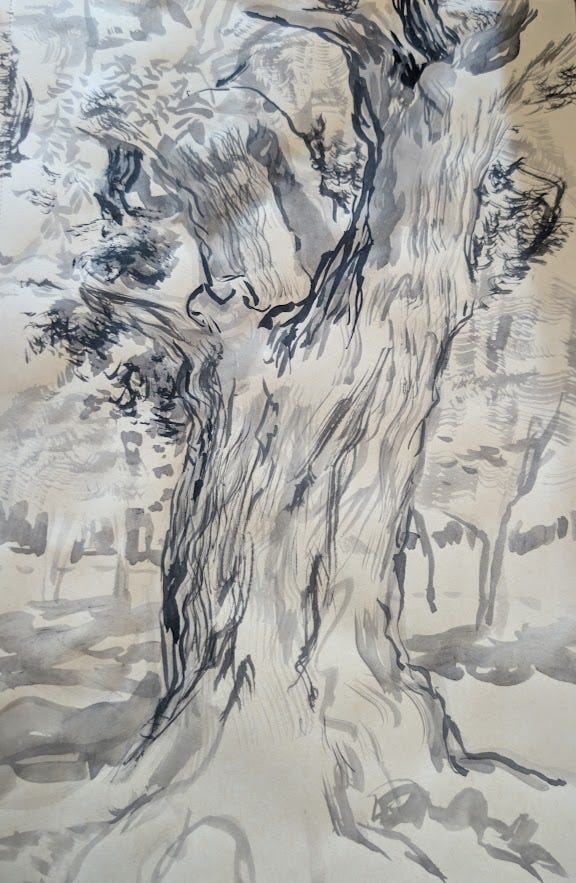
I’m still feeling a bit lost here in IIT Gandhinagar, though I’ve had some incredibly inspiring conversations with faculty and students, which I’ve started writing about (more soon!). But I wanted to tell you about a tree I’ve befriended, right across from my apartment block on campus.
It’s one of the larger, older trees around. Lately, first thing in the morning, around 6:30 am, when the temperature is pleasant and people are out walking and enjoying the fresh air, I sit on a bench just opposite it and do my best to put what I’m noticing down on paper. It’s become a kind of modest anchor for my day.
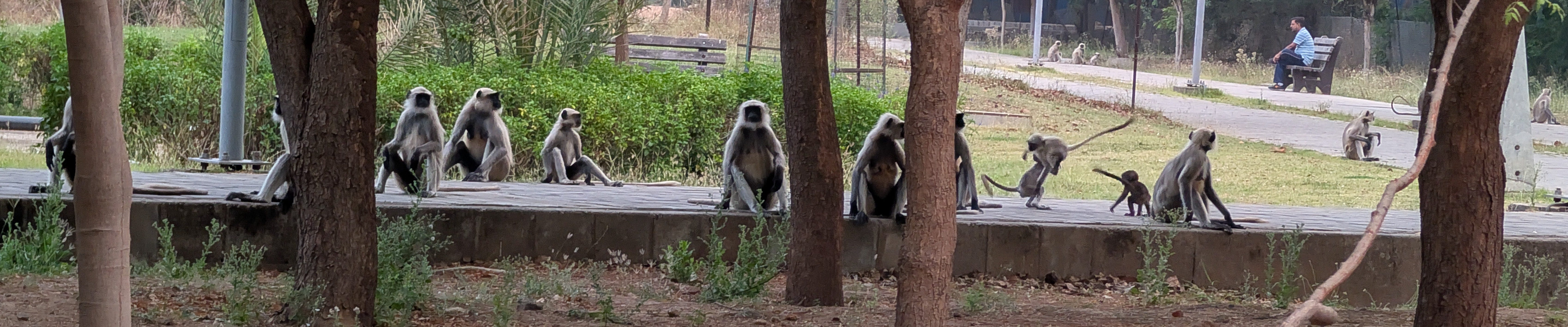
A couple of mornings ago, a troupe of langur monkeys passed through while I was drawing. Suddenly one jumped into the tree I was drawing and stayed there for quite a while. I got a little nervous it would jump down on me, but the langur seemed as content in the tree as I’ve started to feel beneath it. I think I may have left before it did.
Today I came out a bit later than usual, and the sun was already shining brightly on the tree, though the temperature was still comfortable. I had been working on the drawing for a while when a gentleman came by with his young grandson. He stood behind me for some time, watching me draw, and then finally decided to engage me in conversation. Do you know what kind of tree this is? he asked. Of course I didn’t. It’s a Neem tree, he told me. It has all kinds of medicinal properties.
He went over and broke off a small branch, which was a bit upsetting, though he told me the tree was probably no more than thirty years old. That means it must grow remarkably quickly, because it is enormous. Right now it is flowering: tiny white flowers that, he said, cure a fever. Though it only flowers once a year, if you eat them at that time you will stay healthy all year. He ate some and then offered them to me. They had a strong, bitter taste, surprising in such a tiny, delicate flower. The leaves, he said, can cure diabetes, and when he got Covid he chewed them and they helped him recover.
I don’t know whether any of these claims have been verified by science, but I do use neem oil on my roses to keep them healthy, so perhaps what is good for roses is good for us too. In any case, I now have new reasons to admire this tree, which already provides much-needed shade during my morning drawing sessions.
The gentleman went on to tell me that he is from a forested region where lions, tigers, and leopards share the woodlands with people. Since I love trees, he said, I should come visit, and he put his contact information in my phone. (Mr. Patel.) The lions, he said, are not a problem, as long as they’re not hungry. It’s the tigers you have to watch out for. They’ll attack you whether they’re hungry or not.
His tiny grandson, waiting patiently at his feet, grew restless, and Mr. Patel turned to go. You are welcome to come visit, next time you are in India, he said. I’ve received many such invitations since I’ve been here, to fascinating places I won’t have time for on this trip. I’m leaving in two weeks and my schedule is getting quite full. But I’m hoping to return, and perhaps I’ll make it to Mr. Patel’s forests.
I wouldn’t have met Mr. Patel if I hadn’t been sitting there every morning, pencil in hand, looking. Drawing the same tree over and over didn’t make me an expert on it. But it made me someone who could be taught. I arrived in Gandhinagar feeling lost. The tree gave me a place to be. And being in that place, drawing every day, opened something up that moving through would I would have missed entirely.
Heraclitus was reported to have said, "You can't step in the same river twice."
It is, almost certainly, just as accurate to say, you can't sit under the same tree twice, either.
The Neem Tree you sat under, on the day and time you were there, was the particular Neem Tree that Mr. Patel would pass by, notice your drawings, and engage you in an informative conversation about the tree's medicinal qualities. There are many trees, of course that have medicinal qualities. For example, willow bark contains salicin (which is converted to salicylic acid (aspirin) in the body). Bayer figured out how to synthesize this (based on what came from trees).
So, it is fair to say that the conversation with Mr. Patel was about (at least indirectly), Lions and Tigers and Bayer (Oh, my.)
Had you not sat under that particular tree and languored among the langurs, on that particular day, at that particular time, you would never have had that conversation with Mr. Patel, and that would never have led to my pun, oceans away, so the roots and branches of that particular Neem Tree reached farther than anyone (you, Mr. Patel, or I) would have thought.
You never know what a small change (if you'd gone there a little earlier, or a little later, or sat by a different tree) will bring about. You were lucky enough to choose just the right time, and just the right tree, to have had all this happen.
For example, if singer/songwriter Jim Croce had been born in Gujarat (and not Philadelphia) and was dendrophilically proud of his local trees, thinking they compared at least favorably to the conifers common to where we live, he might have sung:
Like the pine trees linin' the windin' road
I've got a Neem, I've got a Neem...
I thought…lions in India? Yes, it turns out. Asiatic lions. Oh!