

Dispatch from Gandhinagar
profoundly lost and strangely at home

Where to begin...
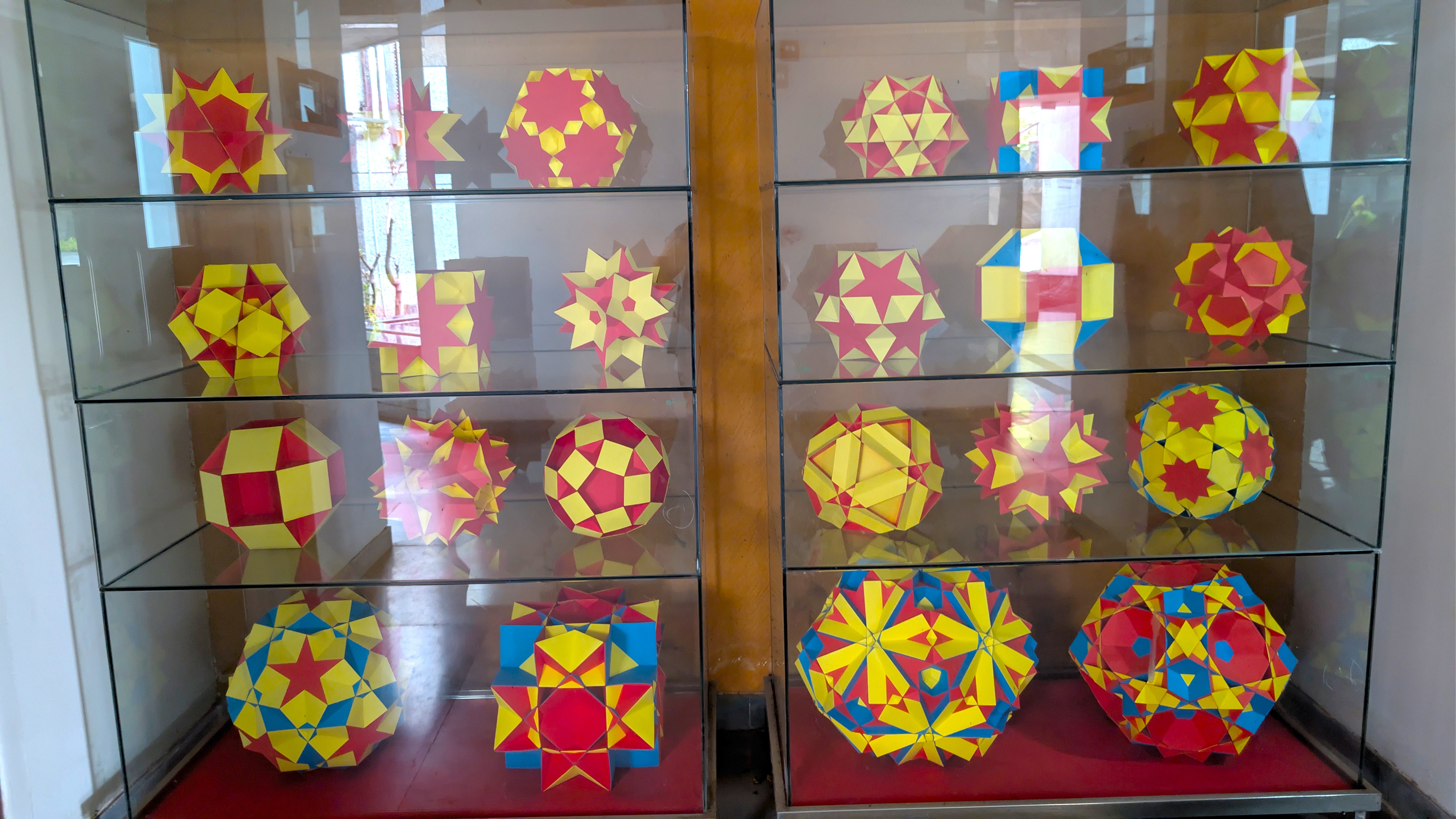
Glass cases of multicolored polyhedra lined the hallway outside the Center for Creative Learning (CCL) at the Indian Institute of Technology Gandhinagar. I was immediately transported to MIT’s Architecture Machine Group, more than four decades ago, when I programmed an animation of multicolored polyhedral transformations in C, which in those days ran on huge mainframe computers the size of large refrigerators. (There was a roomful of them.) I can’t remember at all how I did it, but I do remember the thrill of figuring it out and making it work.
Inside was a huge space with scattered workstations and piles of miscellaneous parts. Manish Jain, the founder of the Center, came over. He explained that his motivation in setting up this Center was to dispel the tedium that takes over children’s lives in school, and to reintroduce play and joy into children’s learning. He set a cup of coffee in front of me and asked me to tell him my life story. Not a common request. I was thrown off guard, my mind blank.
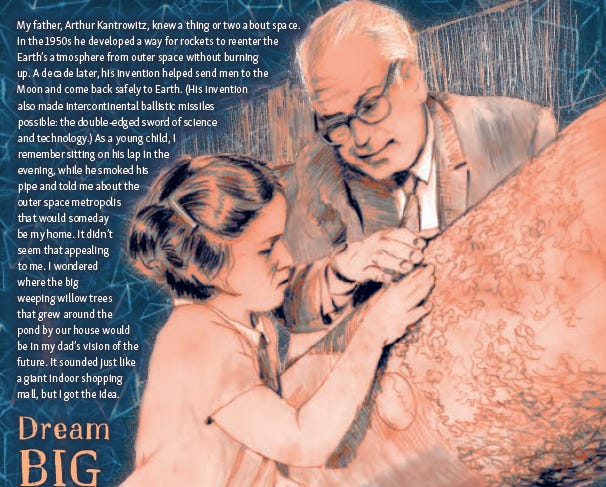
So I just started talking about my dad. It was the first thing that popped into my head. My father was an inventor, a rocket scientist who passionately believed that true creativity begins at the edges of things. He invented the ceramic coating that allowed rockets to reenter the earth’s atmosphere without burning up. His primary research was in aerodynamics and fluid mechanics. He taught me early that the boundary between disciplines is mostly a bureaucratic fiction, and that the most creative and important work is done in the liminal zones between domains. I’ve more or less lived in those in-between spaces ever since.
I surprised myself (and even embarrassed myself a little) by sharing this so quickly with a stranger, something I don’t usually talk about. But for some reason I don’t quite understand, this place makes that kind of conversation feel normal.
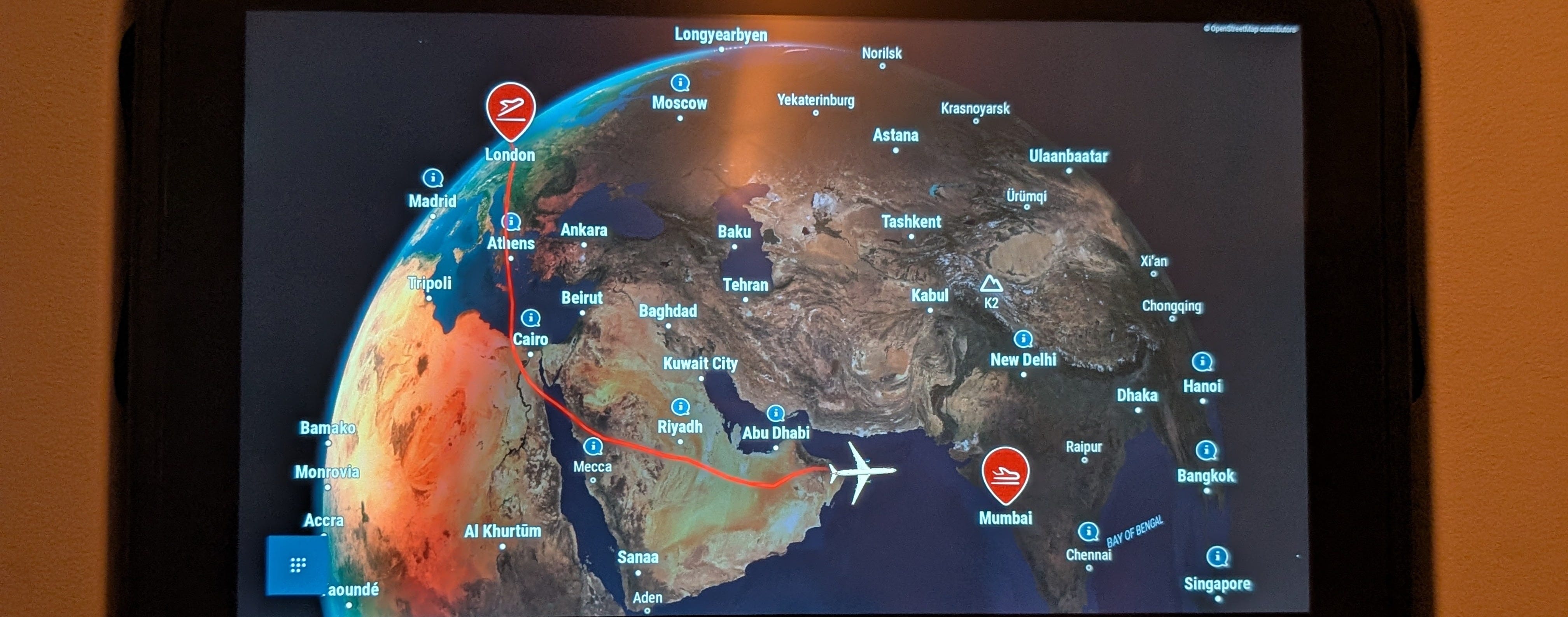
I arrived at IITGN in time for the Curiosity Conference 2026, and I am staying for four weeks as Scholar in Residence. The conference was organized by Argha Manna ( cancer researcher turned comics artist) and Jaison Manjaly (professor of philosophy and cognition.) It brought together artists, researchers, educators, philosophers, science researchers, and communicators from across India as well as local college and high school students. Everyone seemed happy to be there. I don’t know who else felt as I did, that gratification that comes from finding people who also have been working at the boundary between art and science, perhaps a little lonely for it, suddenly not alone.
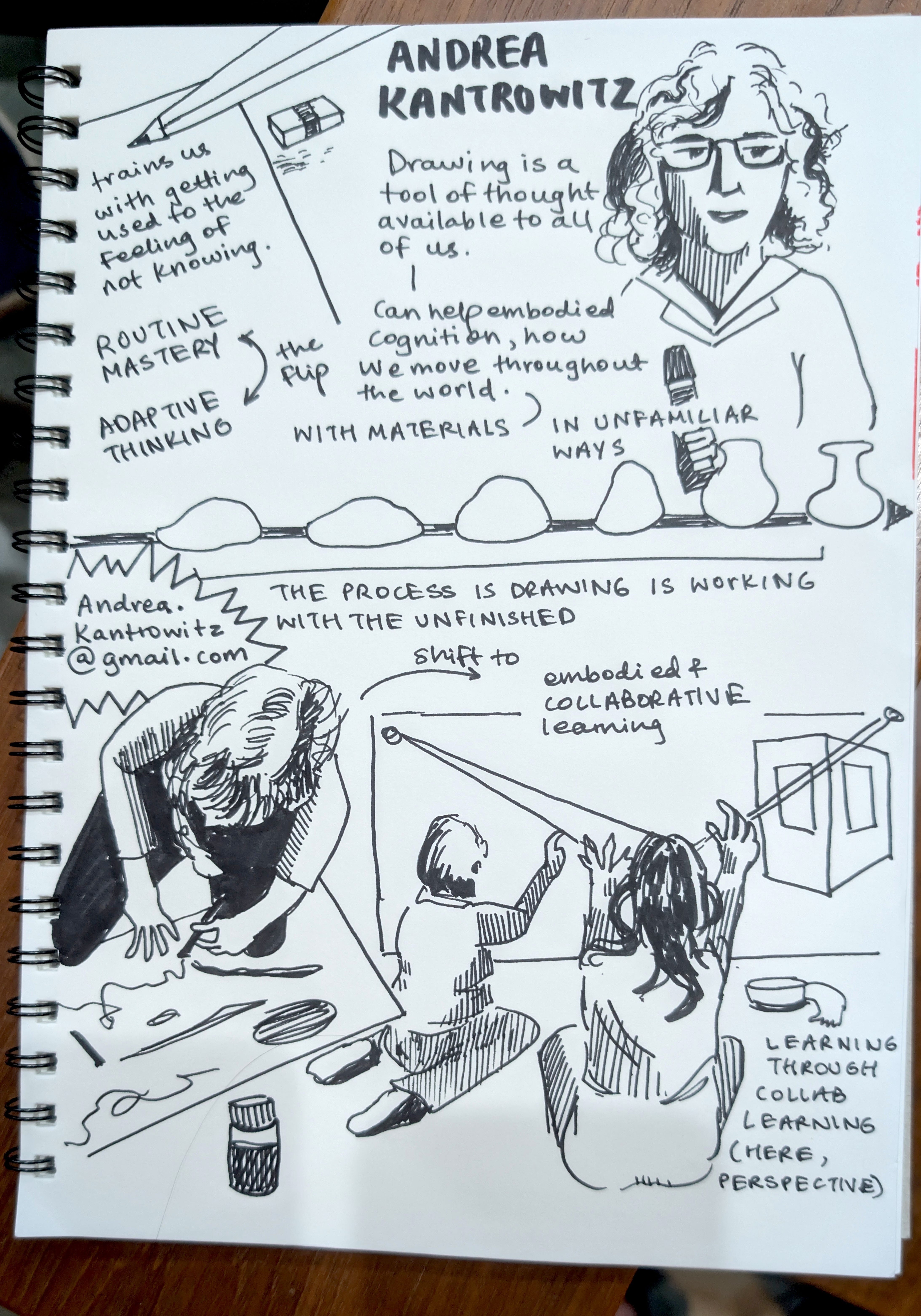
There were a number of engaging presentations by artists, scientists, and artist-scientists. Shailesh BR talked about his Philosophy Machines: mechanized installations that hold life and death, commerce and devotion, absurdity and sincerity in conversation. His machines hold a complexity of meaning that words can’t, that give life to the contradictions inherent in the human condition.
I was also moved by the work Jenia Mukherjee and Pratyasha Nath presented on Kolkata’s East Kolkata Wetlands: a vast, intricate ecosystem of wastewater, fisheries, and centuries of human ingenuity on the edge of the city. Pratyasha is telling this story through comics, which seem well suited to the subject. She is thinking about the gutters of comics, the spaces between the frames, as a metaphor for the actual gutters of Kolkata.
The campus of IIT Gandhinagar itself is a kind of argument. Interdisciplinarity at IITGN is built into the physical structure. Offices don’t cluster by department. Labs are intermingled. The architecture is full of acute angles and unexpected passages, designed, I’m told, to get you lost on purpose. I can confirm it works. I keep thinking I know where I am and then find myself heading in exactly the wrong direction. Spatially, intellectually, linguistically, I have been lost in all three arenas since I arrived. Conversations pull me in, I lose the thread, and then sometimes manage to pick it up again. Sometimes, mid-discussion, people shift into Hindi, and I think I should have tried harder to learn at least a little before I came.
And yet (mostly) I feel comfortable and at home.
But tonight I feel empty, someone who just showed up with a sketchbook and a jet-lagged brain and a series of half-formed ideas. But maybe that is okay. I often say drawing as a form of inquiry, a way of following a line toward what you don’t yet know you want to find out. You have to not-know first. It’s important to allow yourself to get lost.
At the Center for Creative Learning, Manish Jain asked me to tell him my life story and I started with my father. What I didn’t say, but am thinking now: my father would have loved this place and these people. He would have recognized the familiar sparkle of curiosity in their eyes, as I do. I’m still getting used to the coffee.


Picasso reportedly said, "It took me four years to paint like Raphael, but a lifetime to paint like a child."
This past weekend, I visited our 4 month old granddaughter, to whom everything is new, and therefore fascinating and, therefore, the best of its kind she's ever seen. She is swatting about randomly, occasionally hitting a toy or a mobile fixture that has a bell in it, and coming to realize how, through these moments of contact, she can jingle a bell, make a sound, or cause something to wiggle or twirl. In her expression, I can see her thinking, "Interesting. I'll have to remember that. I may be able to use that some day."
We often think of "feeling like a baby" as feeling small, unknowing, and helpless. But as babies, that was when we made our greatest leaps in knowledge. Sometimes, it is when we make the mistake of thinking we know stuff that we lose the infant's ability to learn even more new stuff.
It sounds like this campus is designed to make you feel lost, and designed to provoke random contact that might, if you're lucky, jingle a bell (or something like it) in a way that you may be able to use creatively, some day.
And, maybe you are extra lucky in that this campus has not just given you the opportunity to amble and swat around randomly, like our 4 month old granddaughter, but you have also been transplanted into a world where you don't know the language (again, like our 4 month old granddaughter).
It's as if you've been granted a wish, to be a baby again, and to learn as rapaciously as a baby does, too.
We don't all get to go to foreign labyrinthine campuses, but we can all create our own opportunities to wander and bump into the unexpected, and we shouldn't wait too long to make and take these opportunities.
Picasso also said, "“It takes a very long time to become young." (And Bob Dylan said, "...but I was so much older then; I'm younger than that now.")
This was a really engaging read. The idea of working in those in-between spaces, and the feeling of being both lost and at home, comes through so clearly. There’s something very real in allowing not-knowing to be part of the process.