

Drawing Language
How a linguist teaches English in Ahmedabad with drawing

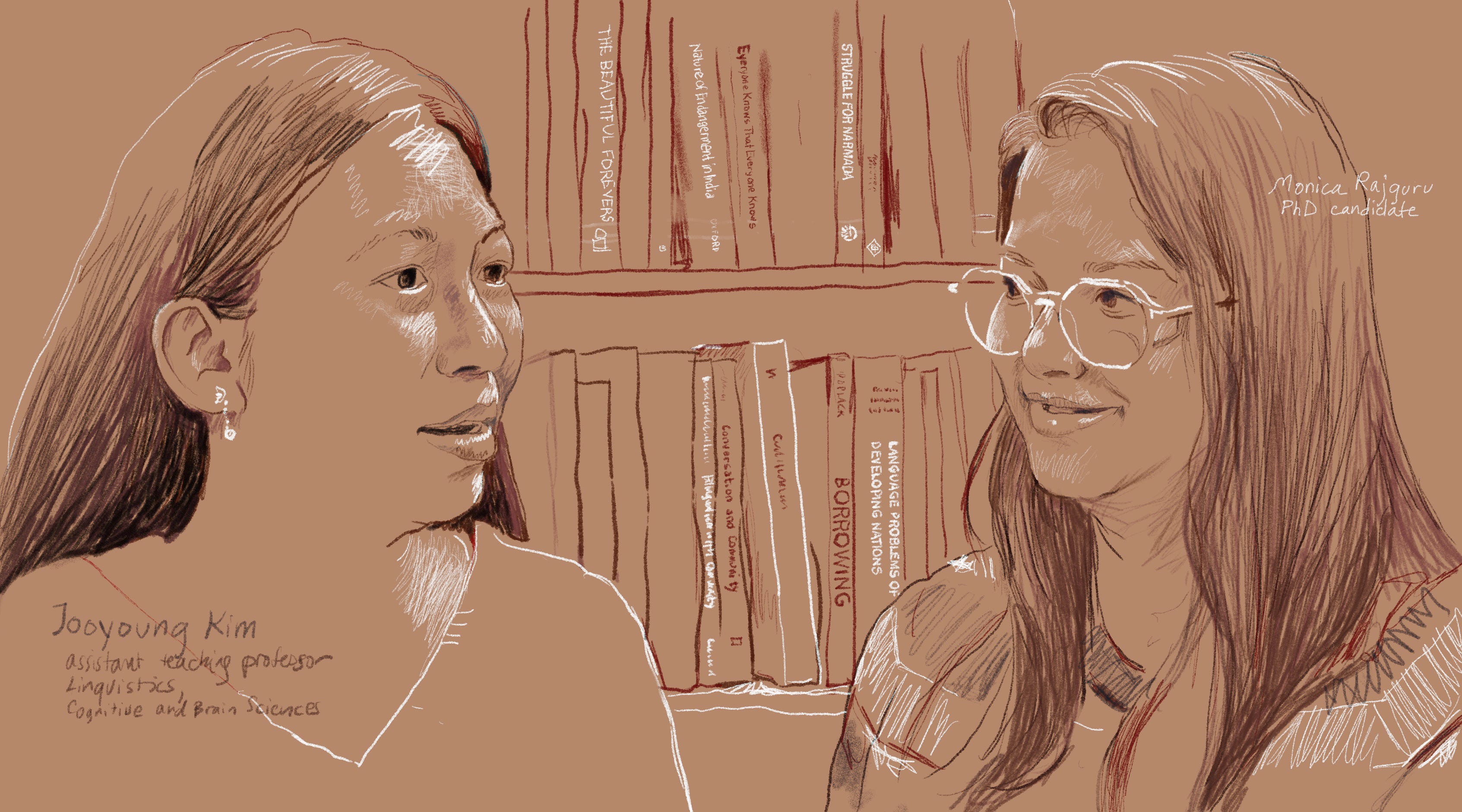
Monica is a PhD student at IIT Gandhinagar, and she enrolled in my short course on thinking through drawing across disciplines. One day she mentioned that her advisor was teaching English to the team at Sanchetana (an NGO in Ahmedabad) and to community leaders from the urban slums nearby. And that she'd asked them to draw. That was enough to make me want to meet the advisor.
Jooyoung is Korean, trained in theoretical linguistics at the University of Delaware in the U.S., and now teaching English at IIT Gandhinagar. She came to Gandhinagar because her husband had a position here. Her research moved from theoretical linguistics toward multilingualism, and her sense of what language teaching is for moved with it.
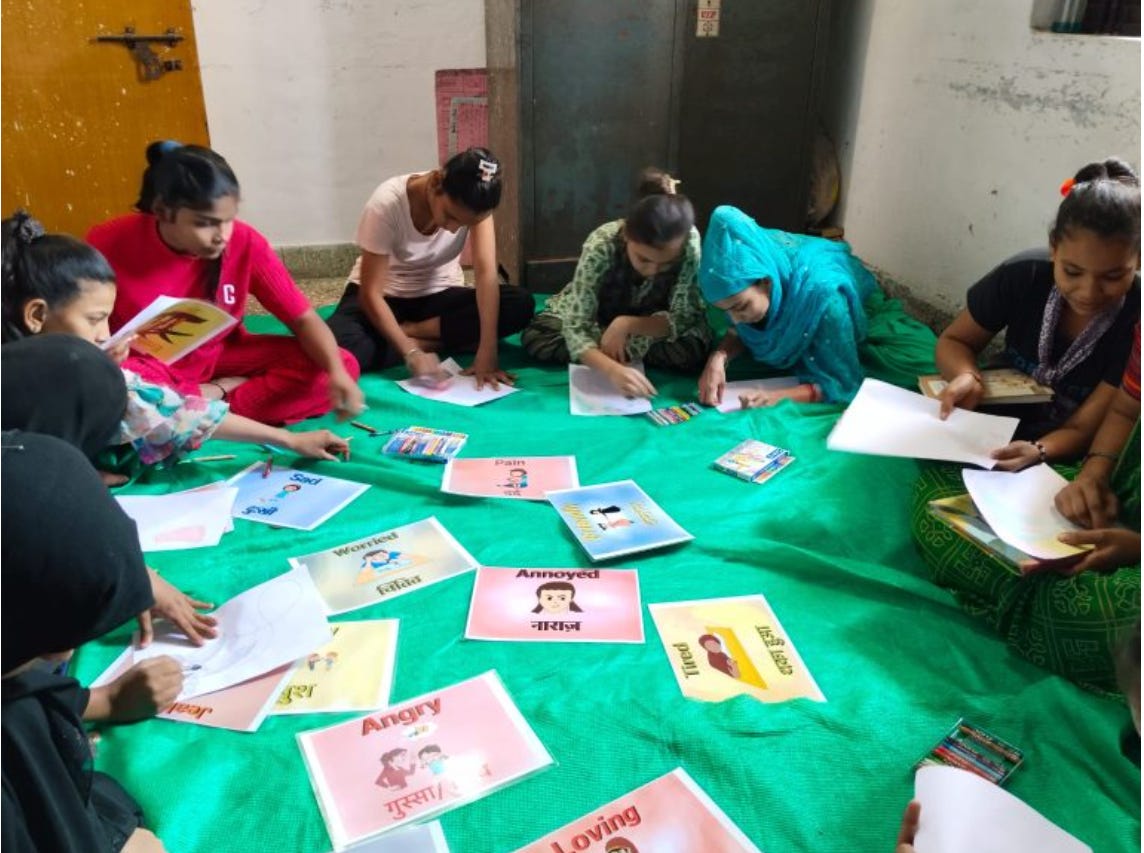
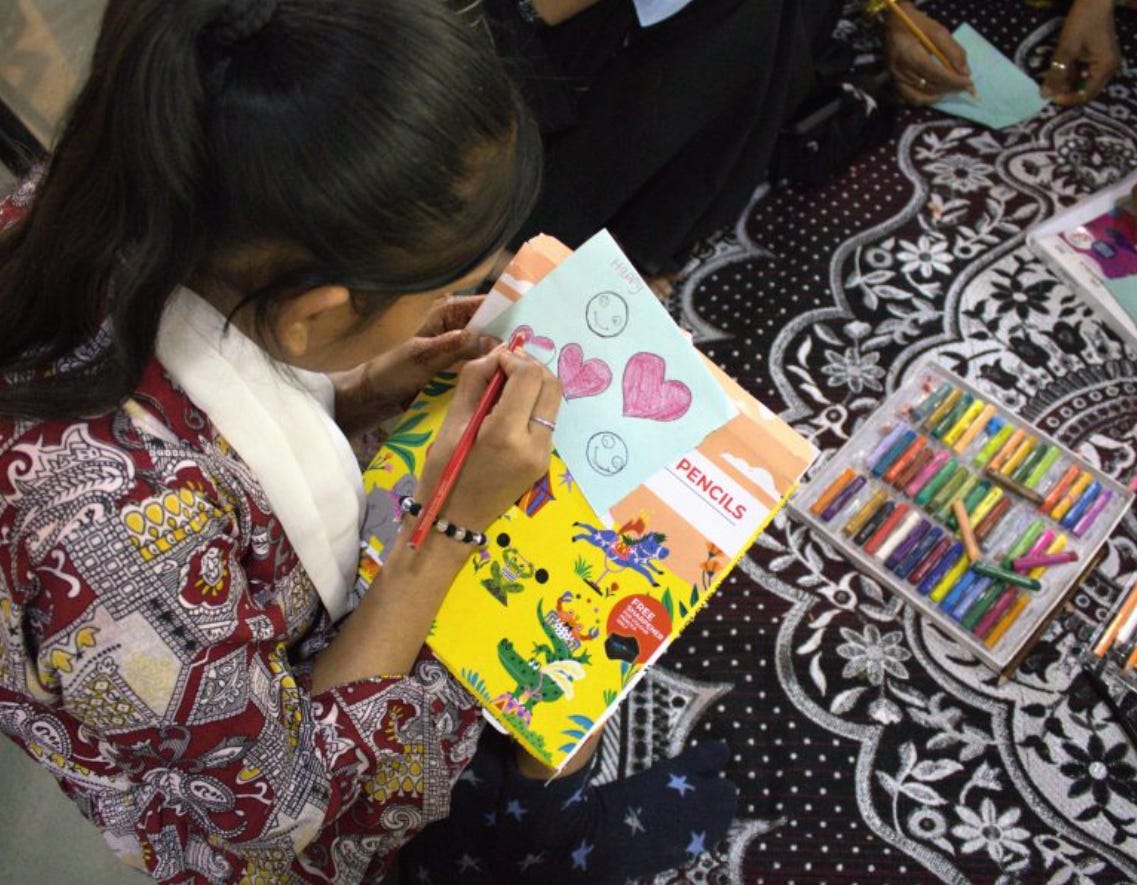
From Sanchetana’s webpage, Emotional Health
Sanchetana was founded over forty years ago by a medical doctor in the Ahmedabad area, it began with community health work, including mental health for women in low-income communities and expanded into vocational training, microloans, literacy, even a ChatGPT workshop. The women Jooyoung works with are project coordinators, program managers, community resource persons recruited from the neighborhoods themselves. Many dropped out of school around fifth or sixth grade.
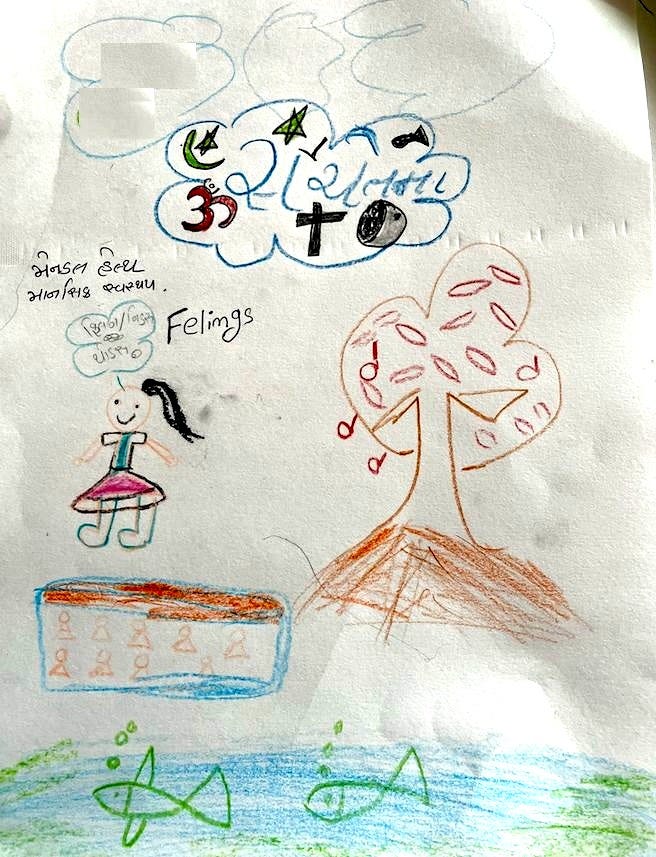
…working with marginalized communities, Sanchetana recognizes the deep-seated emotional health challenges that impact communal relationships. This project uses creative Emotional Health, Art Therapy and Nonviolent communication (NVC) tools to address these issues and build a culture of empathy and cooperation.


The request for English classes was tentative at first, on both sides. “We were all like, let’s just try it,” Jooyoung said. “I didn’t want to just assume English would be useful to them.” Some women wanted to participate more fully in board meetings, which run partly in English. Some wanted to teach English to girls in their communities. One woman, in her thirties, raising two kids, said she wanted to read books. She was interested in nonviolence education and wanted to go deeper. That, Jooyoung said, is the kind of motivation she looks for. “When you’re teaching English, you have to first think about the learning objective,” she said. “Here, why should English writing be the target? What is the target group actually going to use it for?”
She doesn’t teach English the way you might expect: there are no drills and no decontextualized grammar rules. Instead she brings sketchbooks and color pencils and bilingual storybooks from Tulika Press. She also brings blank cards folded from thick paper, with a twelve-month grid inside where the women write or draw what they dreamed about, and later, what they achieved. She asked them to draw their plans for the year, decorate the front cover, sketch what they were working toward. Some drew embroidery machines. One drew a girl being guided toward school. Another drew something about a holiday play, fish in water, a religious symbol Jooyoung couldn't quite place.
“They can express it better without the pressure of English,” she said about the Ahmedabad women. “There’s no hesitation. They’re just talking. And then we add the language layer.”
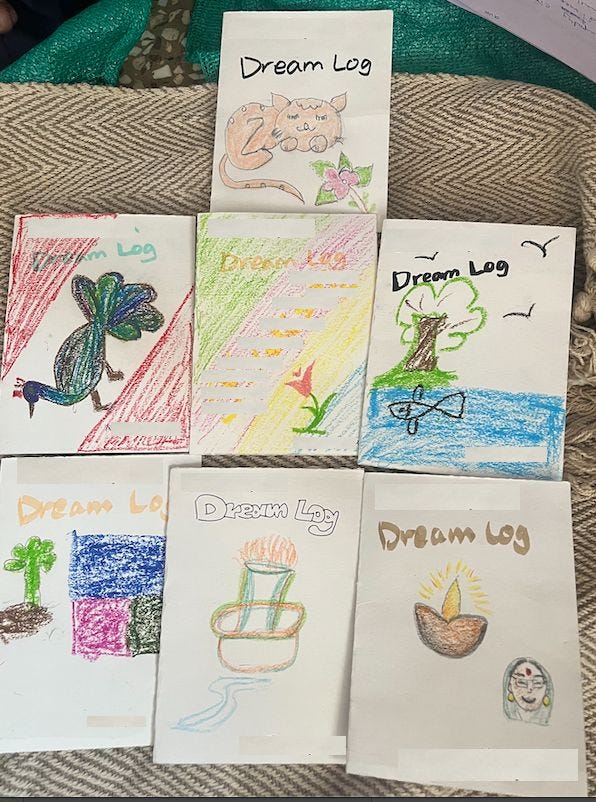
Drawing, in Jooyoung's approach, isn't an art exercise, it's a way to get something down before it can be put into words. Her focus, at Sanchetana and with her students at IIT Gandhinagar, is how language helps us organize and externalize our thoughts, and express our inner lives. English is only the “cherry on top.”
The women at Sanchetana are not learning English to sound impressive. They’re learning it to get a seat at a table where decisions are being made about their communities. That’s a very practical understanding of what language is for.
This connects to something Jooyoung has observed about how multilingualism actually functions in India. She describes the way people here move between languages not as total fluency in multiple systems, but as something more like a “patchwork.” English is used for academic discussion and debate. Jooyoung said she realized she needed to learn Hindi for jokes. People tend to use their mother tongue (of which there are more tha 19,500, categorized into 121 language groups) at home. The languages fill different parts of a person's life, different emotional registers, different social contexts. Each serves a different expressive function.
Jooyoung and Monica volunteer once a month, two hours a session, probably not enough for measurable language acquisition. Jooyoung isn't sure that's the right metric. When she found a Korean bakery in Gandhinagar, she brought cake. When there was a festival, the women made sweets for her. “So it was a more about building connection,” Jooyoung says.
She teaches first-year composition to undergraduates at IIT Gandhinagar who’ve spent years preparing for entrance exams, suppressing their own opinions in favor of correct multiple-choice answers. Her instinct with both groups is to get them talking about something they actually care about before you ask them to write. Let them disagree. Let them ramble. Writing starts with speech, which starts when someone believes they have something to say.
“What we want to train them about,” she said, “is how to think, how to organize, how to assess, how to analyze. The writing is a result of that.”


In one of my drawing workshops at IIT, something unexpected happened that connected to Jooyoung’s approach. I asked participants to draw a real problem in their lives, then work in groups to visualize and eventually solve it. They never got to the solution. They kept elaborating the problem, going deeper into it. Monica described it afterward: “The problem looks very big, but when I was drawing it, it felt like, oh, this is fun. We were so happy describing the problems. We didn’t want to reach the solution.”
(video of problem solving workshop below)
That’s the thing Jooyoung seems to be after, in the NGO and in the classroom: the pleasure of articulation itself. The satisfaction of getting a complicated thing down, even if you never solve it. She’s not trying to produce fluent English speakers. She’s trying to encourage people to trust that their inner lives are worth the effort of expression.
Jooyoung Kim is a professor at IIT Gandhinagar. Sanchetana, the NGO where she volunteers, has been working on women’s empowerment in Ahmedabad for over forty years.
I loved reading this. The idea of drawing as a bridge to expression, before language and sometimes instead of it, really stuck with me. Jooyoung’s approach feels so human and practical, especially her focus on connection and self-expression over rote learning. It’s moving to see how art and language can open doors for people to be heard in their communities.