

Drawing into the Unknown
What drawing teaches us about uncertainty

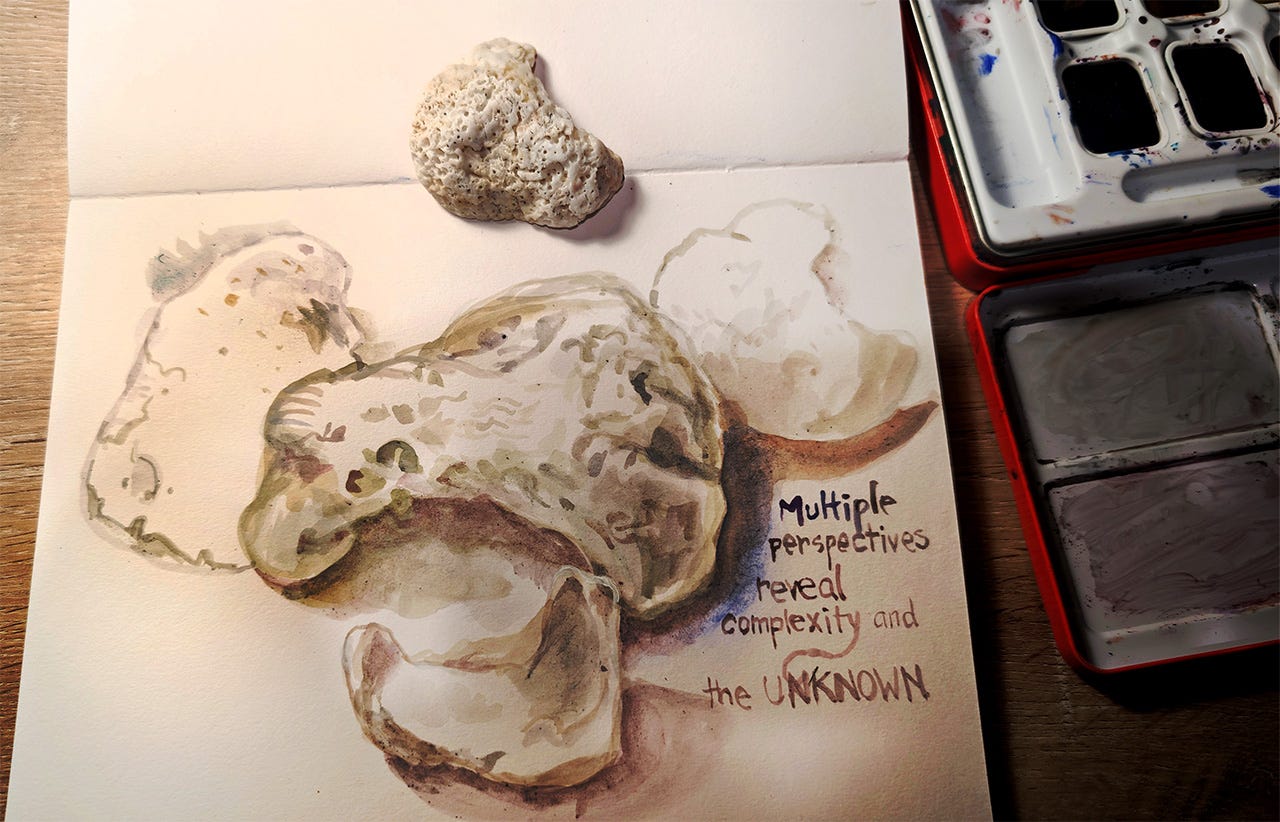
I’ve learned to be okay with the fact that my drawings and paintings always fall short of what I see around me when I am done. Because after I put my paints away, the world seems immeasurably more beautiful and mysterious than it did a short time before, when something caught my eye that I wanted to capture.
It turns out this is not only my personal problem with drawing. It’s a problem with the way we humans perceive the world. We live surrounded by mystery, and we are remarkably good at not noticing. The human brain, and especially the society in which we live these days, is mostly optimized for efficiency. We replace the full strangeness of a face, a tree, a hand with an idea of what we are looking at, a shorthand that gets us through the day without existential vertigo. We don’t see; we recognize. We don’t look; we confirm.
Drawing breaks that spell.
When you sit down to draw something, really draw it, not trace a symbol you already carry, you discover how little you actually know about what you’re looking at. The interplay of angles, the play of light as it filters through the trees. The exact relationship between a table and the wall behind it. Places and objects you may have passed by a thousand times and never, not once, actually seen.
This is the first gift of drawing: it returns you to not-knowing.
What strikes me about drawing is that it is, in practice, a daily reckoning with exactly this. Every line or mark you put down is a hypothesis. It says: I believe the edge goes here. And then you look again, and reality disagrees, and you have to decide: do you defend the line, or do you follow what you see?
Most of us, most of the time, defend the line.
In our short lifetimes, we can scratch only the surface of the world. The more carefully you look at anything — a stone, a sentence, a relationship — the more it opens into depth you didn’t know was there. This is not frustrating. Or rather, it is frustrating, and also the most alive feeling available to us.
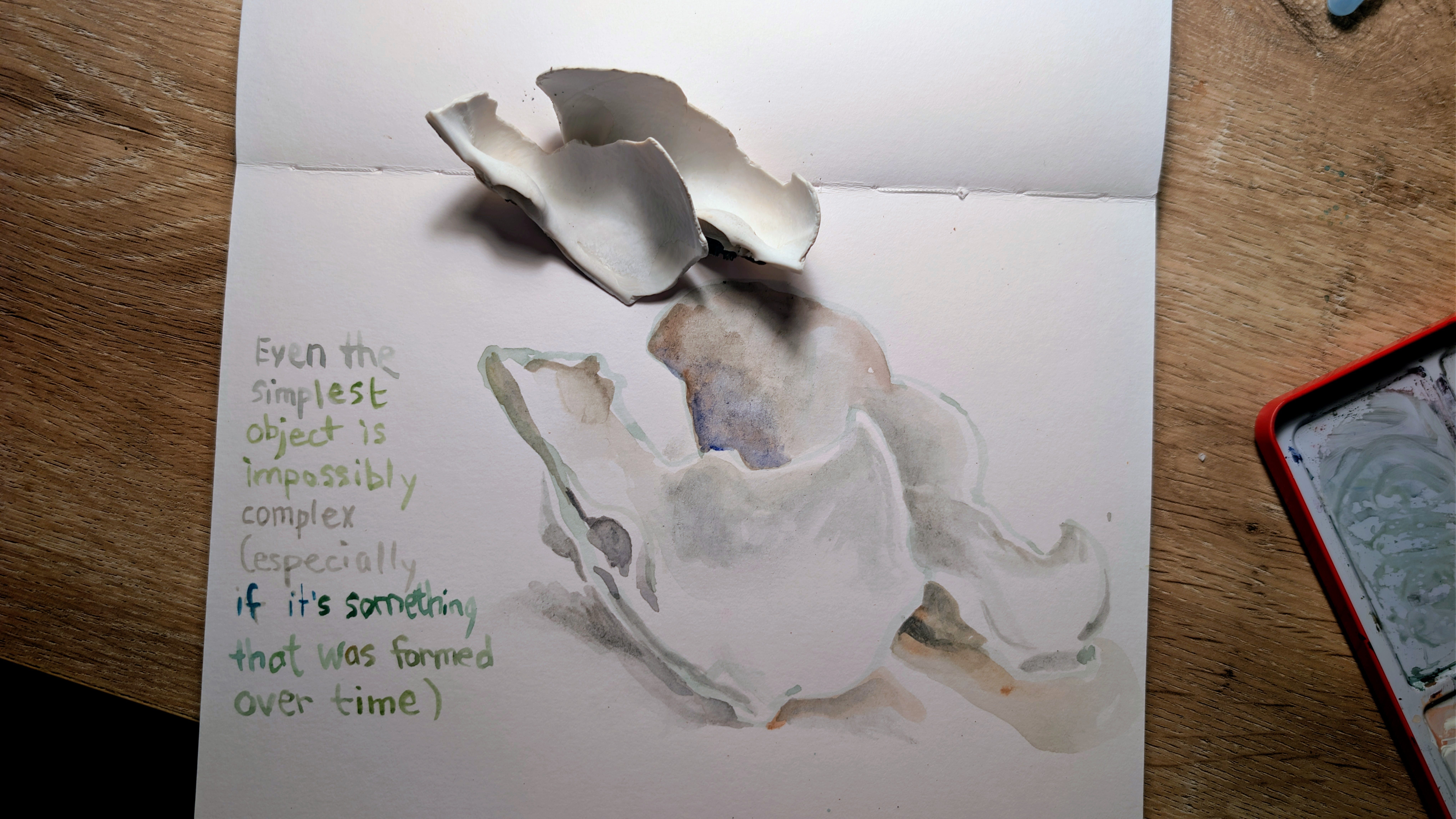
Drawing teaches you to stay in that feeling rather than escape it.
Each mark is provisional. Each session is an ongoing negotiation between what you intended and what the drawing is becoming. The work evolves not by enforcing an ideal, but through sustained, humble attention. What accumulates is not a perfected image; it’s a record of thinking in action, a map of your encounter with something that exceeded your grasp.
Drawing cultivates tolerance. Tolerance for ambiguity, for error. Tolerance for the distance between what you see and what you can put down in arrangements of marks and lines. Tolerance for mystery.
I think this is why drawing can feel unsettling and maybe even a bit scary to people who are otherwise competent and confident. It doesn’t confirm what you already believe. It reveals how much of your knowledge rests on assumptions you never examined, about what things look like, about what you’re capable of, about what’s worth paying attention to.
It brings you face to face with unreason. Not irrationality, but the fertile, uncertain ground beneath logic, where intuition and perception and ambiguity live together.
And here is what I find hopeful in all of this: once you loosen your grip on the perfect picture, things open up. Knowledge becomes more generous. You stop defending your internal map of the world around you and start revising it. You stop performing understanding and start practicing it.
Drawing is my practice of that wonder.
Not a destination. A practice. A way of staying with uncertainty, of working in the crevices rather than sealing them shut; returning, again and again, to the page, where mystery waits patiently for the next mark.
What have you been drawing lately that surprised you with something you’d never actually seen before?
This is so insightful about the mental process of drawing ... how difficult and enjoyable it is and how much you learn - beautifully written
The physicist Werner Heisenberg famously said, in the context of scientific observation: "What we observe is not nature itself, but nature exposed to our method of questioning". I wonder (but don't know - this is MY uncertainty principle...) whether this has some relation to what artists and drawers do. What a drawer observes may not be the thing, itself, but instead may be the thing (or nature) exposed to the drawer's method of looking at it.